
- December 4, 2025
- Posted by: Dr. Vikram Huded
- Category: Stroke
When people think about carotid artery disease, they usually worry about one thing: stroke.
But over the years in our clinic, we began noticing something else in many of these patients—
a slow decline in memory, attention, and overall mental sharpness, even before a stroke ever happened.
We wanted to understand this better.
Can the narrowing of a major neck artery (the carotid artery) reduce blood flow to the brain enough to affect thinking?
And more importantly, can fixing that narrowing—through carotid artery stenting—actually help the brain work better?
To answer these questions, we conducted a study at Narayana Institute of Neurosciences, Bengaluru, and the results were eye-opening.
What We Studied
We followed 31 patients who had significant narrowing of their carotid artery and underwent carotid artery stenting (CAS)—a minimally invasive procedure to open the blocked artery and restore blood flow to the brain.
Before the procedure, each person underwent a detailed cognitive assessment using the Addenbrooke’s Cognitive Examination (ACE), which looks at:
-
Memory
-
Attention
-
Language
-
Visuospatial skills (like drawing or recognizing shapes)
-
Verbal fluency
-
Overall cognitive score
We repeated the test 3 months after stenting.
What We Found — The Brain Actually Performed Better After Stenting
The results were clear and statistically significant:
1. Overall cognitive function improved.
Patients showed a meaningful rise in their total ACE score after the procedure (P = 0.008).
This means the brain was functioning better as a whole.
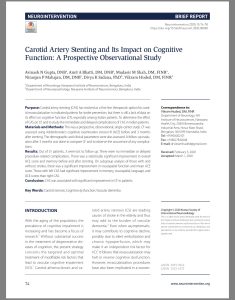
neuroint-2020-00038 (1)
2. Memory improved significantly.
This was one of the strongest findings (P = 0.02).
Patients were remembering better, recalling information more accurately, and showing sharper mental clarity.
neuroint-2020-00038 (1)
3. In those who had previous strokes, “visuospatial skills” and total cognitive score improved.
Even in people with old strokes, we saw gains (P = 0.04).
Their ability to understand spatial relationships or visual information got better.
neuroint-2020-00038 (1)
4. Left-sided carotid stenting gave even greater improvements.
Since the left brain controls language and memory in most people, this finding made perfect sense.
Those who had left-sided stenting improved in:
-
Memory
-
Visuospatial ability
-
Language
-
Total cognitive score
(All with significant P values <0.04)neuroint-2020-00038 (1)
5. No strokes, TIAs, heart attacks, or major complications occurred.
The procedure was safe in all our patients.
neuroint-2020-00038 (1)
Why Does Cognitive Function Improve After Stenting?
A chronically narrowed carotid artery reduces steady blood supply to the brain.
Even if it doesn’t cause a stroke, it can lead to:
-
Silent micro-emboli
-
Low blood flow (hypoperfusion)
-
Slow, gradual decline in thinking and memory
By opening the artery, we restore healthy blood flow.
The brain—especially areas involved in memory—responds well to this improved circulation.
Think of it like watering a plant that has been drying out slowly.
It may not die suddenly, but with proper water supply, it becomes healthier and stronger.
What This Means for the General Public
Most people only think of carotid disease as a “stroke problem.”
But our study shows something equally important:
Carotid artery stenting may help improve or preserve brain function—especially memory—when done for the right reasons.
It highlights a larger idea that is often forgotten:
Good blood flow is essential not just for preventing stroke, but also for keeping the brain sharp.
When Should You Consider Checking Your Carotid Arteries?
You may benefit from a carotid evaluation (usually a Doppler ultrasound) if you have:
-
High blood pressure
-
Diabetes
-
High cholesterol
-
Smoking history
-
Family history of stroke
-
Sudden memory decline
-
Previous TIA or stroke
-
Retinal ischemia or sudden vision changes
Early detection can not only prevent a disabling stroke—it may also protect your memory and cognitive health.
The Bottom Line
Our research clearly shows that in properly selected patients, carotid artery stenting is not just a life-saving procedure—it may also be brain-saving.
If you or your loved ones live with risk factors for stroke or have been told you have carotid narrowing, do not ignore the cognitive aspect. The brain thrives on good blood flow, and restoring it can make a real difference in daily life—how you think, remember, speak, and function.